Over a decade ago, Uruguay’s Los Teros made history in Montevideo. In front of a capacity crowd at Estadio Charrúa, the South Americans defeated Russia to claim the final spot at the 2015 Rugby World Cup. For a team built primarily on amateur players, it was a monumental achievement, and one that marked the beginning of Uruguay’s modern rise on the global stage.
That qualification didn’t just earn Uruguay a ticket to England. It signalled to the rugby world that Los Teros were more than just occasional visitors. Since then, they have featured in every World Cup, upsetting Fiji in 2019 and competing fiercely again in 2023. The seeds of that progress were planted in 2014, when Pablo Lemoine’s side outplayed Russia in the repechage decider.
In this retrospective, we revisit Alfredo Vivo’s original match report from that unforgettable day in Montevideo, a day that changed the trajectory of Uruguayan rugby.
Editor’s Note: The following match report was originally written by Alfredo Vivo in October 2014. It has been republished as part of Rugby Rising’s archive series, with new context and updates.
Finally! Uruguay have qualified for the 2015 Rugby World Cup after a twelve year absence from the tournament.
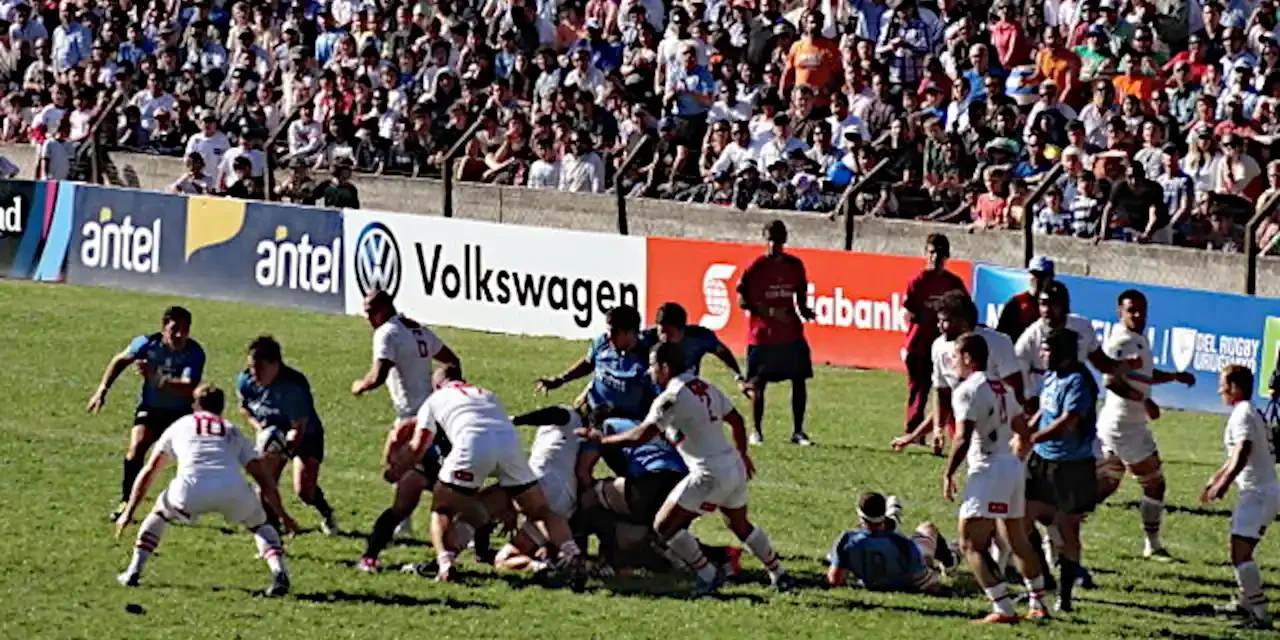
The final match of the repechage playoffs was played in excellent weather conditions, in front of a record capacity crowd of 15,000 fans at Charrúa Stadium in Montevideo. It was ‘Los Teros’ who booked the last ticket for the Rugby World Cup this Saturday.
The convincing 36-27 win resulted in a 57-49 overall aggregate in favor of the hosts, after Russia had clinched a win by a single point, in Krasnoyarsk, Siberia two weeks before.
This will be Uruguay’s third participation at the main event, having previously played in the tournament in Wales in 1999 and Australia in 2003
First half analysis:
It was a real battle in the first half, Uruguay continued to utilise their typical, forward orientated game and dominated the scrum and breakdown battle.
The Russians didn’t seem to vary the game plan that worked for them in Krasnoyarks two weeks prior. They attempted to dominate proceedings with a three-quarter game and utilising the full extent of their carrying and passing skills.
Fly half Yuri Kushnarev opened the score in the tenth minute for the Bears, but the match was soon tied when Uruguay’s number ten, Felipe Berchesi equalised.
Berchesi added an additional three points after being rewarded a penalty for a collapsed scrum.
Kushnarev equaled the scores a few minutes later after being awarded a penalty for failing to release the ball in the tackle. This infringement seemed to be a recurring problem for ‘Los Teros’ in the first period and they were duly punished for it.
The Russians took the lead with another penalty, but Berchesi equalized immediately after.
A third scrum collapse by the Russians gave Uruguay the opportunity to kick another penalty. Berchesi did not fail in his attempt, taking the home side into a 12-9 lead. The crowd was confident and pleased at this stage, as the home team were dominating and imposing conditions in the scrums and showing an excellent attitude on defensive.
Uruguay then gave away a soft penalty that was punished by the boot of Kushnarev, and two minutes later the South Americans were once again penalised for not releasing the ball in the tackle.
The Uruguayan players and spectators seemed to be anticipating another kick for poles, but the clever thinking Russian fly-half took a quick tap penalty and off-loaded to scrum half, Alexandr Lanushkin, who scored the first try of the match. This was to be the final score of the first half, putting Russia into a slender 12-17 lead.
Coincidently, the first half scores were exactly the same over both ties, and ‘Los Teros’ found themselves in the same situation, having conceded a soft try in the closing periods in both games.
Second half analysis:
Despite the Russians converting another penalty goal and extending the difference to eight points, the second half was for Pablo Lemoine’s ‘Teros’.
The Uruguayans were more aggressive than the visitors in almost every facet of play. A monumental performance from Castres Rodrigo Capó Ortega deserves a special mention.
Uruguay fought back and scored three spectacular tries to clinch the last ticket to the Rugby World Cup in England in 2015.
The first try was the result of some brilliant play by the ‘Los Teros’ backs, which included an excellent run by scrumhalf Agustín Ormaechea. Loosehead prop Alejo Corral scored from a very well-worked rolling maul and the final try came from Stade Montois player, Agustín Ormaechea, who scored from the back of a scrum, taking the score to 33-20.
Tsnobiladze scored Russia’s second try, late in the second half, which was converted by Berchesi but it was to no avail. Uruguay finished the game as 36-27 victors.
The celebrations have most certainly started for Uruguay. Four years of hard work have culminated in the realisation of a dream. This was a monumental achievement for a squad made up of mostly amateur players.
Once the celebrations have settled down, the coaches, players and union staff will have to start thinking about the team’s objectives and goals for next year. Uruguay is going to the sports’ greatest showpiece and will play England, Wales, Australia and Fiji in possibly the most competitive pool in the tournament. This is a great opportunity and a great challenge for an amateur rugby nation who’s squad is selected from only eight, first division clubs and 5,000 registered players.
Teams:
Uruguay: 1) Alejo Corral, 2) Nicolás Klappenbach, 3) Óscar Durán; 4) Santiago Vilaseca, 5). Rodrigo Capó; 6) Juan Gaminara, 7) Diego Magno, 8) Alejandro Nieto; 9) Agustín Ormaechea, 10). Felipe Berchesi; 11). Jerónimo Etcheverry, 12) Alberto Román, 13) Joaquín Prada, 14) Santiago Gibernau, 15) Gastón Mieres.
Coach: Pablo Lemoine
Russia: 1) Grigory Tsnobiladze, 2) Valeriy Tsnobiladze, 3) Andrei Igretso; 4) Alexander Voytov, 5) Krill Kulemin; 6) Andrey Temnov, 7) Andrey Ostrikov, 8) Victor Gresev; 9) Alexandr Ianushkin, 10) Iurii Kuhsnarev; 11) Vladimir Ostroushko, 12) Dimitrii Gerasimov, 13) Mikhail Babaev, 14) Denis Simplikevich; 15) Vasily Artemyev. Coach : Raphael Saint Andre
Uruguay substitutions: 16. Arturo Ávalo, 17. Carlos Arboleya, 18-Franco Lamanna, 19. Mathías Palomeque, 20. Juan De Freitas, 21. Leandro Lievas, 22 Alejo Durán
Russia substitutions: 16. Valdislav Korshunov, 17. Evgenii Pronenko, 18. Andrei Garbuzov, 19. Pavel Butenko, 20. Igor Klyuchnikov, 21. Alexey Scherban, 22. Ramil Gaisin
The Scorers:
10’ penalty Kushnarev (RUS) 0-3
14’ penalty Berchesi (URU) 3-3
21’ penalty Kushnarev (RUS) 3-6
24’ penalty Kushnarev (RUS) 3-9
26’ penalty Berchesei (URU) 6-9
33’ penalty Berchesi (URU) 9-9
37’ penalty Kushnarev (RUS) 9-12
39’ penalty Berchesei (URU) 12-12
40’ try Simplikevich (RUS) 12-17
45’ penalty Kushnarev (RUS) 12-20
51’ try Prada converted Berchesi (URU) 19-20
56’ try Corral converted Berchesi (URU) 26-20
64’ try Ormaechea converted Berchesi (URU) 33-20
76’ try Tsnobiladze converted Kuhsnarev (RUS) 33-27
80’ penalty Berchesi (URU) 36-27.
Venue: Estadio Charrúa;
Attendance: 15,000
Referee: Romain Poite (FRA)
Yellow cards: Simplikevich y Kulemin (RUS), Carlos Arboleya (URU)
Looking Back, Looking Forward
That day in Montevideo was more than just a qualification playoff. It was the spark that reignited Uruguayan rugby and set Los Teros on a path toward becoming one of the most respected emerging nations in the game.
The lessons learned in 2014–2015 carried Uruguay into their famous 2019 Rugby World Cup upset over Fiji, a result that echoed around the rugby world. By 2023, Uruguay was no longer seen as a plucky outsider but as a team capable of challenging Tier One nations with skill, structure, and belief.
As the road to the 2027 Rugby World Cup begins, Uruguay continue to build on that foundation. With a blend of experienced internationals and a new generation of talent, Los Teros are once again preparing to prove that they belong on rugby’s biggest stage.
What happened at Estadio Charrúa in October 2014 was a turning point, not only for Uruguayan rugby, but for the wider story of the sport’s emerging nations. It showed that passion, resilience, and unity can bridge the gap between amateurs and professionals, and that rugby’s future is being written well beyond the traditional powers.
At Rugby Rising, we’ll be following every step of Uruguay’s journey to 2027 and beyond.
👉 Explore more in our Uruguay Rugby hub for the latest news, players, and analysis of Los Teros.